
The three stages of creosote
Creosote builds up in three stages: dry soot that brushes off, crunchy black flakes that take more work, and a hard, shiny glaze that is the most flammable and the hardest to remove. The earlier it's caught, the easier and safer it is to deal with.
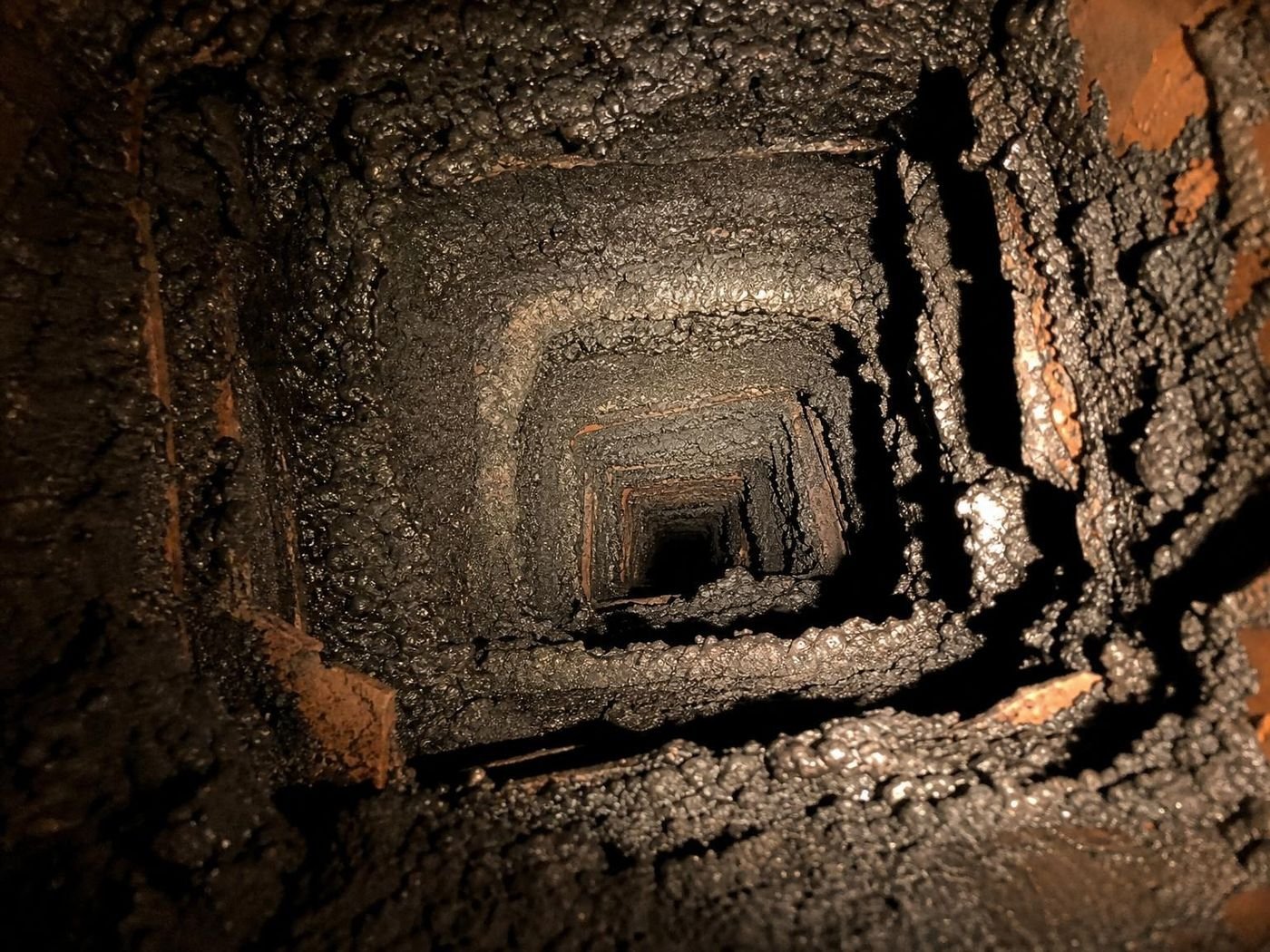
What creosote is
Wood smoke carries unburned gases, tiny droplets of tar and water vapor. As that mix rises through the chimney, it cools. When it cools enough, it condenses on the flue walls and leaves a deposit. That deposit is creosote.
Every wood fire makes some. A hot, well-fed fire sends most of the smoke up and out before it can condense. A cool, smoky fire leaves much more behind. Creosote is flammable, and it collects in the one place in your home that's designed to get hot. That's why it matters.
The three stages
Chimney professionals usually describe creosote in three stages, sometimes called first-, second- and third-degree. They aren't always neat layers. One flue can have all three at different heights, depending on how warm each section runs.
| Stage | What you'll see | How it's removed |
|---|---|---|
| 1 | Dull, dusty, soot-like layer that wipes off on a finger | Standard sweeping with brushes |
| 2 | Black crunchy flakes or granules, sometimes shiny | Stiffer brushes or rotary tools |
| 3 | Hard, glossy glaze, often with drips; hard to scratch | Specialist chemical treatment and rotary tools, sometimes relining |
Stage 1: dry soot and powder
The first stage is a dark, dusty or flaky layer, a lot like soot. It forms in flues that draft well and get plenty of hot air. It isn't harmless, since it still burns, but it brushes off easily. A standard chimney sweep with the right brush removes it.
Stage 2: crunchy, shiny flakes
The second stage looks like black, crunchy flakes or granules, sometimes with a shiny, tar-like surface. It tends to show up when the fire doesn't get enough air: glass doors kept closed, a damper only partly open, or a stove turned down low. It sticks harder to the flue and usually needs stiffer brushes or rotary tools to remove.
Stage 3: glazed creosote
The third stage is the one to worry about. It's a hard, glossy coating that can look like tar that has run down the flue and set, or like a layer of black candy. It is concentrated fuel. It's very difficult to remove with a brush, and it keeps building on itself, because the glaze makes the flue surface even more restrictive. CSIA guidance is that glazed creosote needs specialist removal, typically with chemical treatments that change the glaze into a form that can be swept out, often over more than one visit. In some flues it can't be fully removed, and the liner has to be replaced.
Why it matters: chimney fires
Creosote is what burns in most chimney fires. When enough of it builds up and the flue gets hot enough, it can ignite. Some chimney fires are loud and dramatic. Others smolder quietly and go unnoticed until someone finds the damage later.
Either way, a chimney fire burns far hotter than a flue is designed to handle day to day. It can crack clay tiles, warp metal liners and dampers, and damage the masonry. Once a flue is cracked, heat and fire can reach the wood framing around the chimney. Our guide to chimney fire warning signs covers what to look and listen for.
What causes heavy buildup
Creosote builds fastest when smoke is cool, wet and slow-moving. The usual causes:
- Wet or unseasoned wood. The fire spends its energy boiling off water, burns cooler and makes more smoke. Seasoned firewood is generally around 20% moisture or less. How dry the wood is matters more than whether it's oak or pine.
- Not enough air. Closed glass doors on an open fireplace, a damper that isn't fully open, or a stove's air control turned way down for a long overnight burn.
- A cold flue. Chimneys on an outside wall, common on older Pittsburgh houses, lose heat to the outdoors, so more smoke condenses on the way up.
- A flue that's too big for the appliance. A stove or insert vented into an oversized masonry flue without a properly sized liner drafts slowly and coats the walls. A correctly sized liner fixes this.
- Short, smoky fires. Lots of small fires that never get the flue properly hot build up more deposits than fewer, hotter ones.
How to check your own fireplace
You can get a rough idea of what's in the lower part of your chimney yourself. Do it when the fireplace is completely cold.
- Open the damper and shine a bright flashlight up past it, at the smoke shelf and the first part of the flue.
- Look at the color and texture. Matte, dusty black is early buildup. Flakes, bubbles or a shiny, wet-looking surface are later stages.
- Scratch a small area above the damper with a screwdriver or a pocket knife. If the groove is about 1/8 inch deep or more, it's time for a sweep.
- If you see a hard, glossy coating that barely scratches, stop using the fireplace until a professional has looked at it.
How to slow buildup down
- Burn dry, split, seasoned hardwood or softwood. Store it off the ground and covered on top, with the sides open to air.
- Burn hot, bright fires. Give the fire enough air, especially when you first light it and the flue is cold.
- Open the damper fully whenever there's a fire, and follow your glass doors' instructions. Many tell you to keep them open while the fire is burning.
- Don't burn trash, cardboard, gift wrap or treated wood. They burn unpredictably and some leave harmful residues.
- Get an inspection every year, as NFPA 211 calls for, and a sweep when buildup reaches about 1/8 inch. See how often to sweep.
Creosote-removal logs and powders can make some deposits easier to sweep out, but they don't remove buildup on their own and aren't a substitute for a sweep and an inspection.
What professional removal looks like
For stage 1 and most stage 2 deposits, removal is a normal sweep: protect the room with drop cloths, run a HEPA vacuum to keep soot contained, brush the flue from top or bottom, clean the smoke chamber and firebox, and inspect. We photograph what we find so you can see it for yourself.
Stage 3 is a different job. It usually involves applying a treatment that softens or changes the glaze, waiting for it to work, then removing it with rotary tools, and checking with a camera afterwards. Heavy glaze can take more than one visit. If the glaze has damaged the flue, or can't be removed safely, relining the chimney may be the right answer. You'll get a written estimate with photos before any of that work happens.
The bottom line
- Stage 1 is normal buildup that a regular sweep removes.
- Stage 2 means the fire isn't getting enough air. Sweep it, and fix the cause.
- Stage 3 is glazed, highly flammable and needs specialist removal. Stop using the fireplace until it's dealt with.
- Dry wood, hot fires and a yearly inspection are the best prevention.
Common questions
What does creosote look like?
Can I remove glazed creosote myself?
Do creosote sweeping logs work?
Why does my fireplace smell like tar in the summer?
Related guides & services
Chimney fire warning signs
The sounds, smells and after-the-fact clues of a chimney fire, and what to do if you suspect one.
Read the guide MaintenanceHow often to sweep
Inspection and sweeping schedules for wood, gas, oil and pellet appliances.
Read the guide ServiceChimney liners
Stainless steel relining for damaged or oversized flues on wood, gas and oil appliances.
See the serviceReady when you are.
Book online in about a minute, or call and talk to a real person. We confirm your 2-hour arrival window by text.